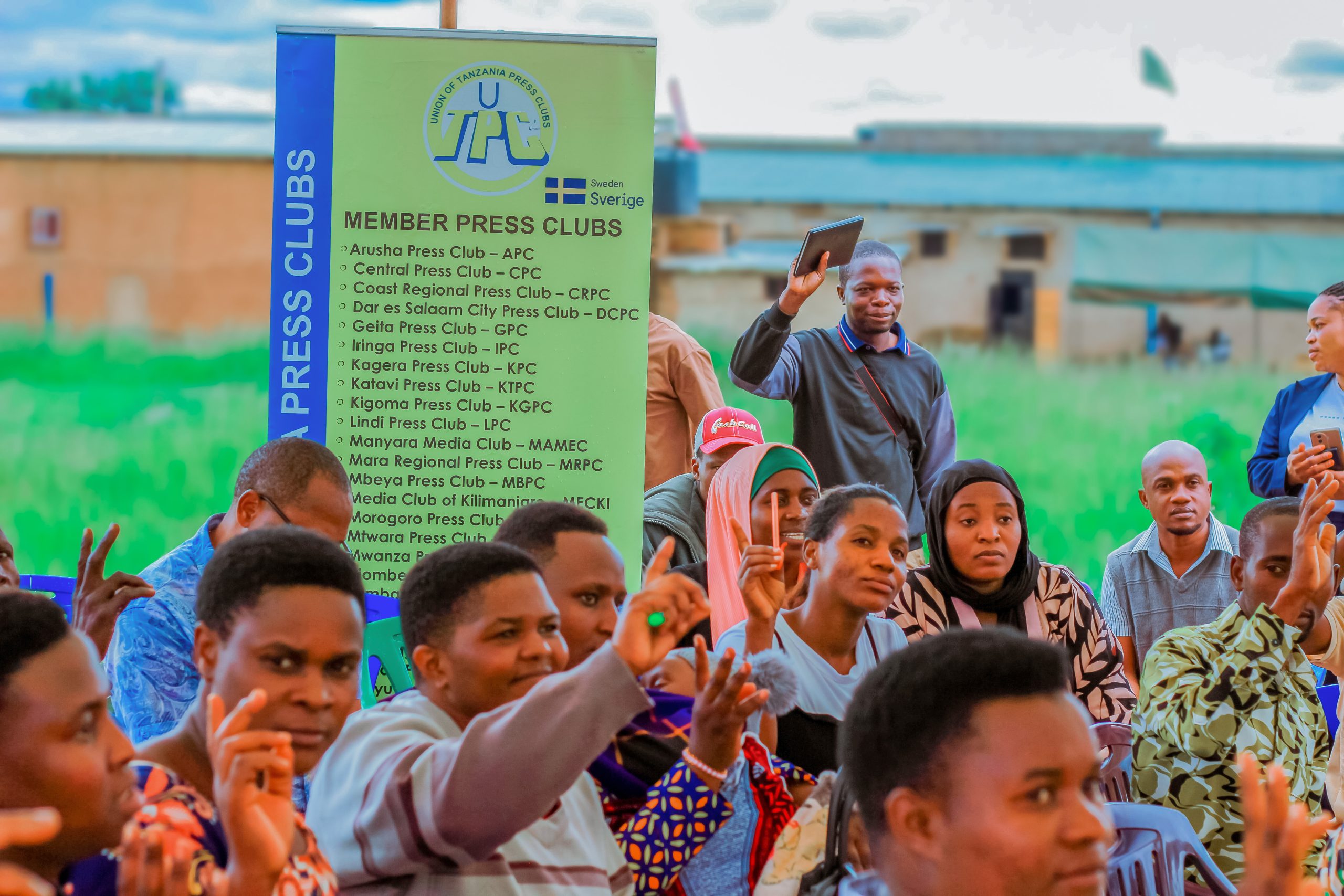
By Hamad Rashid
News has the power to transform society, but that power depends on who is heard and how citizens’ voices are represented. In Songwe Region, residents are beginning to raise new questions about the role of the media in carrying their voices and driving social and economic development.
These concerns emerged during a seminar that brought together citizens from different groups alongside journalists from Songwe Region and neighboring areas. The seminar was conducted under a project aimed at building the capacity of journalists so that communities can access accurate, balanced, and public-interest information.
The project is implemented by the Union of Tanzania Press Clubs (UTPC) in collaboration with International Media Support (IMS), with funding from the European Union and and Embassy of Switzerland in Tanzania.
Citizens begin questioning the role of the media
Julieth Shombe, a farmer and leader of seed producers from Mbozi District, said her participation in the February seminar opened her eyes to the real role of journalists in society.
“Today I have understood that a journalist stands in the middle between citizens and authorities,” said Julieth.
However, she raised a fundamental question about the reality of that role, wondering why, at times, when citizens present their challenges to journalists, the resulting stories fail to reflect reality or address issues that bring meaningful benefits to the community.
Contributing to the discussion, ADP Mbozi Project Coordinator Edward Mwakagile expressed surprise following an assessment conducted by seminar participants and presented by the facilitator, Tanzania Media Foundation Executive Director, Dastan Kamanzi.
The assessment compared the balance of power among journalists, citizens, and authorities. The findings showed that journalists still have limited power in amplifying public voices, while citizens possess even less influence, and authorities appear to hold comparatively greater power.
“What has caused the journalists we depend on as a bridge for development to have such limited power?” Edward questioned.
Journalists acknowledge challenges in the balance of power
Responding to the concerns, Tunduma-based journalist Mathias Njibala admitted that the power of the media remains weaker compared to that of authorities.
He explained that during the training they learned about three types of power within a nation: political power (authority), people’s power, and media power which must remain balanced for development to be achieved.
“When one power outweighs the others, social prosperity becomes difficult to attain. When citizens and journalists have less power while authorities hold more, it becomes difficult to produce development-focused stories,” said Njibala.
Some citizens with journalists at the seminar, participating in the activity with facilitator Dastan Kamanzi
Public-interest journalism encouraged
The seminar trainer and Tanzania Media Foundation Executive Director, Dastan Kamanzi, said public-interest journalism requires a balanced environment between authorities and society, where each side recognizes its responsibility toward national development.
He explained that the discussions aim to promote journalism that reflects community needs while encouraging citizens to recognize their power in collaborating with the media.
“These platforms aim to remind us of the power of public-interest journalism in fostering community and national prosperity,” said Kamanzi.
He added that public-interest journalism seeks to hold authorities accountable while empowering citizens with knowledge, voice, and the ability to actively participate in governance.
The Constitution recognizes people’s power
According to the Constitution of the United Republic of Tanzania of 1977 (2005 Edition), state authority originates from the people, and the Government has a duty to remain accountable to its citizens.
Article 8(1) (a): “All sovereign power in the United Republic is vested in the people, and the Government shall derive all its power and authority from the people in accordance with this Constitution.”
Article 8(1) (c): “The Government shall be accountable to the people.”
ARTICLE 9, Directive Principles of State Policy
“(a) that state authority and all its agencies are exercised for the purpose of promoting the welfare and development of the people;
(b) that the Government shall ensure that human dignity is preserved and upheld in accordance with the principles of equality and justice;
(c) that Government activities shall be conducted in a manner that ensures national wealth is preserved, developed and utilized for the benefit of all citizens;
(d) that the Government shall make deliberate efforts to eliminate all forms of exploitation, intimidation, discrimination, corruption, oppression or favoritism;
(e) that Government activities shall be conducted in a way that ensures every person enjoys equal opportunities;
(f) that the Government shall take deliberate measures to promote national economic growth and ensure citizens fully participate in economic activities;
(g) that the Government shall strive to safeguard and strengthen national dignity.”
Journalists express concern
Songwe-based journalist Moses Ng’wat said challenges in the balance of power continue to limit journalists’ full freedom to report on issues of public interest.
He emphasized that cooperation among stakeholders could expand the role of public-interest journalism in national development, a point supported by other journalists present at the seminar
UTPC promotes closer engagement with communities
While opening the seminar held at CCM Vwawa Grounds in Mbozi District, Songwe Region, UTPC Executive Director Kenneth Simbaya said the gatherings aim to encourage journalists to engage directly with citizens in order to understand their priorities.
“We expect this culture to continue so that journalists understand the real challenges and needs of the communities they serve,” said Simbaya.
Some citizens with journalists at the seminar.
Special groups gain a voice
Another participant, Anastazia Mwashiuya, a representative of persons with disabilities, said the training helped her understand the role of the media in highlighting challenges facing special groups.
“From now on, we will work closely with journalists to share issues affecting persons with disabilities,” she said.
She also called on the Government to strengthen cooperation with the media to enable public-interest journalism.
Call for journalists to return to professional principles
Songwe Press Club Chairperson Stephen Simbeye said the seminar reminded journalists of their fundamental responsibilities, acknowledging that despite authorities holding greater power, some journalists have drifted away from the principles of public-interest journalism.
Moreover, Songwe residents now expect journalism that directly reflects their daily lives, while stakeholders continue to emphasize cooperation among communities, media, and authorities to strengthen development through public-interest reporting.
Kenneth Simbaya: UTPC Director during the seminar