By Hamad Rashid
In the streets of Morogoro, Khalifa Mutabuzi watches the youth passing before him and sees something missing, it is not that they haven’t gone to school but rather they lack real-life skills guidance. Khalifa is a citizen who believes that the problem starts from afar in the roots of upbringing, noting that the foundation of life from birth until school fails to prepare a youth to face the reality of today’s world.
Khalifa says with emphasis, “Many young people lack real-life guidance because if you try to look at the background, that is, the foundation of life that raised them from the time they were born until now, it is one of the reasons why many youth have values that are not well-grounded”.
These explanations by Khalifa provide a picture of the large gap existing between classroom education and a young person’s ability to lead themselves in daily life.
Global Challenge, Employment Crisis and Skills (Soft Skills)
This situation in Tanzania is not unique, but is part of a major global challenge. The United Nations Educational, Scientific and Cultural Organization (UNESCO) has been emphasizing the importance of providing youth with technical and social skills through World Youth Skills Day, which is celebrated every July 15 with the goal of ensuring youth are employable or can employ themselves in a rapidly changing labor market.
According to the report from the International Labour Organization (ILO) titled “World Employment and Social Outlook 2026 (WESP 2026)”, released in January 2026 in Geneva, Switzerland, it warns that youth continue to struggle to find employment. However, the report found that while the global unemployment rate is estimated to remain at 4.9 percent in 2026, which is equivalent to 186 million people worldwide still lack access to quality jobs. Institutions such as the World Economic Forum (WEF) and the ILO point out that the main obstacle is not a lack of certificates, but a lack of “soft skills” or life skills.
ALiVE Project: Assessing and Treating the “Disease” of Skills in Tanzania
To address this situation, the organizations Uwezo Tanzania, Milele Zanzibar Foundation, and the University of Dar es Salaam are implementing the Assessment (now, Action) for Life Skills and Values in East Africa (ALiVE) Project, this project conducted an in-depth assessment in 2022 across 45 districts in Tanzania, targeting youth aged 13 to 17 to determine their competencies in four key areas: self-awareness, problem-solving, collaboration, and respect.
The results of that assessment were shocking and should be a call to action for every development stakeholder. Ninety-two percent (92%) of Tanzanian youth in that age group lack basic life skills and values; that is, their ability for self-awareness, problem-solving, and collaboration is low. For example, in the life skill of problem-solving, the assessment found that only 8% of youth have problem-solving abilities, meaning that out of every 10 youth, only two youth are capable of solving problems.
Uwezo Tanzania, National victory with MZF, UDSM to advocate life skills
The significant success of the advocacy by Uwezo Tanzania and its partners has manifested at the policy level, Baraka Mgohamwende the Executive Director of Uwezo Tanzania, confirms that their efforts to collaborate with education authorities in the country have produced lasting results.
Mgohamwende notes “We have been in the process of introducing life skills and values issues into the National Education Framework in collaboration with the Tanzania education authority and that exercise is complete, and the framework is now ready, carrying the issues of life skills and values just as we are required to proceed with them”. He also stated that in our new education curriculum, life skills have also been included, which is a major step that will ensure every child passing through the education system in the country gains the foundations of these competencies.
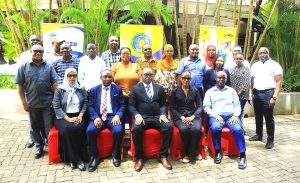
The Uwezo Tanzania team, led by its Director Baraka Mgohamwende (seated at the center), together with leaders from the Media Council of Tanzania, Milele Zanzibar Foundation, and journalists being trained to focus on education and life skills issues, at Morogoro Hotel.
What Exactly Are Life Skills?
Regarding the actual meaning of the term “Life Skills,” Samson Sitta explains, “When we say life skills, these are skills that enable a person to live in terms of relating to people, but also help them understand themselves, manage their emotions and other matters, but thirdly, they help them in how to interact or cooperate with other people, manage emotions, and the ability to manage stress, which help them live well in different environments, whether at work, at home, or even in the streets when with their friends”.
Without these skills, a young person cannot succeed at home, in the streets, or in the workplace, even if they have high academic achievement, Sitta added.
Uwezo Tanzania supporting other organizations to prepare Champion Parents for life skills.
Real change cannot occur without involving parents and guardians. The GLAMI organization from Morogoro region has been an exemplary model in this, through ALiVE campaigns with support from Uwezo Tanzania, they succeeded in preparing a total of 50 champion parents for life skills and values in Morogoro District, who have now become ambassadors for promoting life skills for their children and in the communities surrounding them.
Deborah Ijiko, Project Manager of GLAMI in Morogoro, explains their strategy of starting with one skill after another to bring about lasting results. “We had started first with problem solving. Why? Because we saw it was a very big need for the youth; that is, if they know problem solving, they will know how to communicate and how to be creative to solve problems”.
Deborah believes that when one skill is used well, it triggers others such as critical thinking and effective communication.

Deborah Ijiko: Project Manager of GLAMI in Morogoro
Call for Cooperation, Phase Three (2025-2030)
The journey of the ALiVE project is now entering a new and exciting stage, in its third phase which takes five years (2025-2030), the goal is to strengthen the today and tomorrow systems, to improve teacher training so they can teach these skills effectively, strengthen curricula, teaching guidelines, and increase the budget for developing youth competencies at all levels.
Building a generation with life skills is not a luxury, it is a necessity for the prosperity of the nation as these stakeholders have shown. This work requires the cooperation of everyone, from a parent in the village to a policymaker in the city.