The blue horizon of the Indian Ocean, once a symbol of abundant livelihoods for Tanzania’s coastal communities, is increasingly becoming a contested frontier.
According to a landmark joint report released in April 2026 by the Legal and Human Rights Centre (LHRC) and the Commission for Human Rights and Good Governance (CHRAGG), the livelihoods of nearly 195,000 people directly engaged in fishing, along with more than 4.56 million others who depend indirectly on the sector, are facing growing threats.
At the heart of the crisis is “Governance of Tenure” the legal and social recognition of who has the right to access and use specific resources, for how long and under what conditions.
The fisheries sector contributes 1.7% to Tanzania’s national GDP and provides roughly 30% of the country’s daily animal protein intake. Yet, the report reveals a troubling reality: small-scale fishers (SSF) are increasingly being squeezed out of the coastal waters and fishing grounds they have relied on for generations.
The “Coastal Squeeze” and Human Rights
The report identifies a phenomenon it describes as the “coastal squeeze,” in which the rapid expansion of the Blue Economy including tourism, industrial fishing and extractive activities such as gas and mining is increasingly displacing local communities, both physically and economically.
The report argues that this is more than a failure of resource management. It is also a human rights concern.
The lack of secure tenure directly threatens the Right to an Adequate Standard of Living and the Right to Food, as enshrined in the International Covenant on Economic, Social and Cultural Rights (ICESCR).
Without legally defined zones or areas guaranteeing exclusive access, small-scale fishers are often left as the “weaker party” when competing for coastal resources with large-scale industrial interests.
Living in the Shadow of Displacement: The Human Cost
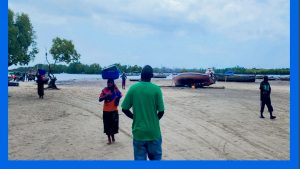
The report’s findings are brought into sharper focus through examples of communities that have lost access to fishing grounds and coastal resources on which their livelihoods have depended for generations.
Mafia Island
In one striking example, small-scale fishers in Mafia reported losing more than 60% of their traditional fishing grounds following the establishment of the Mafia Island Marine Park (MIMP).
The report also documents concerns over the construction of the Thanda Hotel, which has reportedly restricted local fishers’ access to traditional fishing grounds they have used for generations.
Bagamoyo (Mbegani)
In Bagamoyo, the report documents the forced displacement of fishers from Pande Village to make way for the construction of a modern harbour.
For the affected families, the transition has significantly altered their way of life, leaving many in a state of deep socio-economic vulnerability.
Tanga (Moa Ward)
In Moa Ward, Tanga, the establishment of the Kirui Island Marine Reserve introduced restrictions that have weakened the connection between local fishers and the traditional fishing grounds on which they have historically depended.
According to the report, affected communities were not provided with mechanisms for compensation or alternative livelihoods.
The Legal Gap
Despite Tanzania’s progressive Fisheries Act of 2003 and the Marine Parks and Reserves Act of 1994, the report identifies a critical legal gap.
There is currently no specific legal zone designated for traditional subsistence fishing in either marine or inland waters. The absence of such spatial recognition makes customary fishing rights difficult to protect and enforce.
For some fishers, even existing consultation processes do not necessarily translate into meaningful participation in decision-making.
As one fisher from Moa Village told researchers:
“A guest will come, and fishers are called to talk to him. The next day, decisions are made, and you are told that you participated in the process.”
The account highlights the gap that can exist between consultation and genuine participation in decisions affecting fishing communities.
A Call for a Human Rights-Based Approach
The report calls on the Tanzanian government to move beyond conventional “co-management” approaches and adopt a stronger Human Rights-Based Approach (HRBA) to fisheries and coastal resource governance.
Among its recommendations, the report says the Ministry of Livestock and Fisheries (MLF) should first formally demarcate exclusive access zones for small-scale fishers to prevent encroachment by industrial trawlers.
Second, it calls for mandatory financial compensation and livelihood restoration programmes for fishers displaced by Blue Economy investments or conservation measures.
The report further emphasises that displacement is not necessarily physical. Losing economic access to the sea and traditional fishing grounds can also have profound consequences for livelihoods and human rights, requiring appropriate restitution.
The report was developed and published with financial support from the Swedish International Development Cooperation Agency (Sida), as part of efforts to support stakeholders and the government in shaping a more secure and sustainable future for Tanzania’s small-scale fishers.
The report also serves as a reminder that, if Tanzania is to achieve the goals of Vision 2050, the country’s Blue Economy must grow without leaving behind communities that have depended on and protected its coastal resources for generations.
At the heart of that future is secure tenure. Without it, the rights, livelihoods and traditional access of millions of people who depend on Tanzania’s coastal and fisheries resources risk being left unprotected.